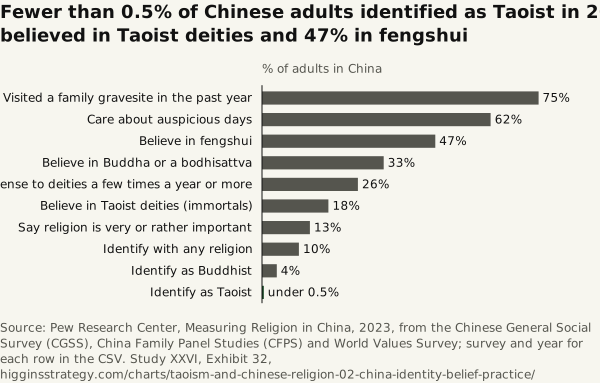
Fewer than 0.5% of Chinese adults identified as Taoist in 2018; 18% believed in Taoist deities and 47% in fengshui
Source. Pew Research Center, Measuring Religion in China, 2023, from the Chinese General Social Survey (CGSS), China Family Panel Studies (CFPS) and World Values Survey; survey and year for each row in the CSV.
Method and data
Method. The first four rows ask about religious identity (zongjiao); the rest about belief and practice. “Visited a family gravesite” is Pew’s “three-quarters.”
| Measure | Share of adults (%) | Survey | Kind |
|---|---|---|---|
| Identify as Taoist | 0.5 | CGSS 2018 (fewer than 0.5%) | identity |
| Identify as Buddhist | 4 | CGSS 2018 | identity |
| Identify with any religion | 10 | CGSS 2018 | identity |
| Say religion is very or rather important | 13 | World Values Survey 2018 | identity |
| Believe in Taoist deities (immortals) | 18 | CFPS 2018 | belief |
| Burn incense to deities a few times a year or more | 26 | CFPS 2016 | practice |
| Believe in Buddha or a bodhisattva | 33 | CFPS 2018 | belief |
| Believe in fengshui | 47 | CFPS 2018 | belief |
| Care about auspicious days | 62 | CGSS 2018 | practice |
| Visited a family gravesite in the past year | 75 | CGSS 2018 (three-quarters) | practice |
Download taoism-and-chinese-religion-02-china-identity-belief-practice.csv