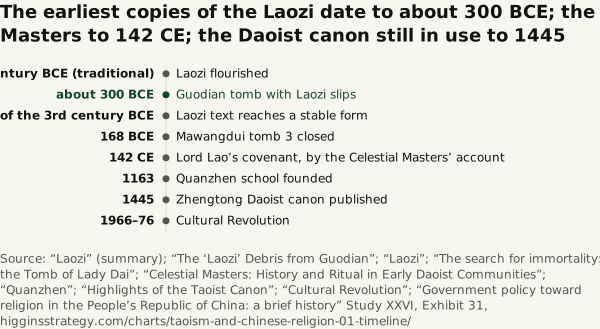
The earliest copies of the Laozi date to about 300 BCE; the Celestial Masters to 142 CE; the Daoist canon still in use to 1445
Source. “Laozi” (summary); “The ‘Laozi’ Debris from Guodian”; “Laozi”; “The search for immortality: the Tomb of Lady Dai”; “Celestial Masters: History and Ritual in Early Daoist Communities”; “Quanzhen”; “Highlights of the Taoist Canon”; “Cultural Revolution”; “Government policy toward religion in the People’s Republic of China: a brief history”
Method and data
Method. Dates as given by the cited source; the Laozi date for the 6th century BCE is traditional.
| Date as stated | Event | Source URL |
|---|---|---|
| 6th century BCE (traditional) | Laozi flourished | https://www.britannica.com/summary/Laozi |
| about 300 BCE | Guodian tomb with Laozi slips | https://reli.franklin.uga.edu/sites/default/files/inline-files/guodian.pdf |
| middle of the 3rd century BCE | Laozi text reaches a stable form | https://plato.stanford.edu/entries/laozi/ |
| 168 BCE | Mawangdui tomb 3 closed | https://smarthistory.org/tomb-of-lady-dai |
| 142 CE | Lord Lao’s covenant, by the Celestial Masters’ account | https://www.colorado.edu/rlst/celestial-masters-history-and-ritual-early-daoist-communities |
| 1163 | Quanzhen school founded | https://www.britannica.com/topic/Quanzhen |
| 1445 | Zhengtong Daoist canon published | https://theme.npm.edu.tw/TaoFollows/en/page_3 |
| 1966–76 | Cultural Revolution | https://www.britannica.com/event/Cultural-Revolution |