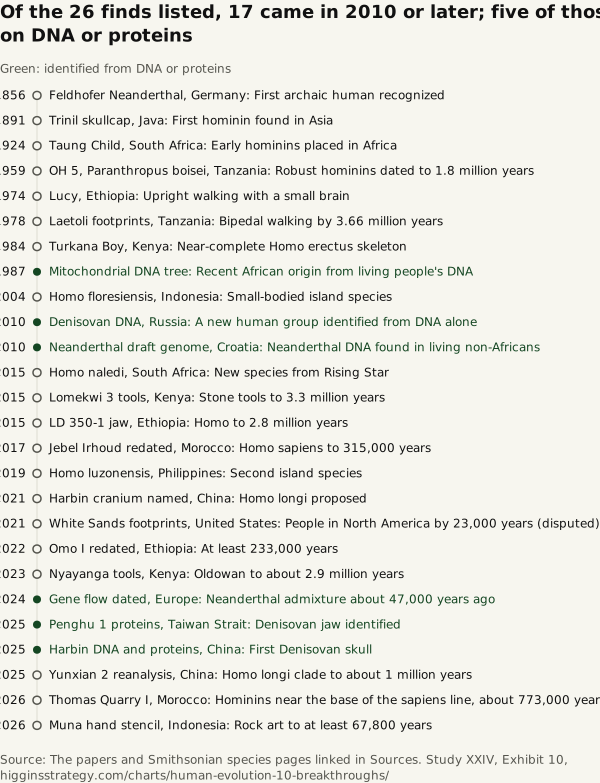
Of the 26 finds listed, 17 came in 2010 or later; five of those rested on DNA or proteins
Source. The papers and Smithsonian species pages linked in Sources.
Method and data
Method. As published.
| Year | Find | Place | What changed | Kind | Source |
|---|---|---|---|---|---|
| 1856 | Feldhofer Neanderthal | Germany | First archaic human recognized | fossil | Smithsonian Human Origins Program |
| 1891 | Trinil skullcap | Java | First hominin found in Asia | fossil | Smithsonian Human Origins Program |
| 1924 | Taung Child | South Africa | Early hominins placed in Africa | fossil | Smithsonian Human Origins Program |
| 1959 | OH 5, Paranthropus boisei | Tanzania | Robust hominins dated to 1.8 million years | fossil | Smithsonian Human Origins Program |
| 1974 | Lucy | Ethiopia | Upright walking with a small brain | fossil | Smithsonian Human Origins Program |
| 1978 | Laetoli footprints | Tanzania | Bipedal walking by 3.66 million years | fossil | Smithsonian Human Origins Program |
| 1984 | Turkana Boy | Kenya | Near-complete Homo erectus skeleton | fossil | Smithsonian Human Origins Program |
| 1987 | Mitochondrial DNA tree | — | Recent African origin from living people's DNA | molecular | Cann, Stoneking and Wilson, Nature, 1987 |
| 2004 | Homo floresiensis | Indonesia | Small-bodied island species | fossil | Brown et al., Nature, 2004 |
| 2010 | Denisovan DNA | Russia | A new human group identified from DNA alone | molecular | Krause et al., Nature, 2010; Reich et al., Nature, 2010 |
| 2010 | Neanderthal draft genome | Croatia | Neanderthal DNA found in living non-Africans | molecular | Green et al., Science, 2010 |
| 2015 | Homo naledi | South Africa | New species from Rising Star | fossil | Berger et al., eLife, 2015 |
| 2015 | Lomekwi 3 tools | Kenya | Stone tools to 3.3 million years | dating | Harmand et al., Nature, 2015 |
| 2015 | LD 350-1 jaw | Ethiopia | Homo to 2.8 million years | fossil | Villmoare et al., Science, 2015 |
| 2017 | Jebel Irhoud redated | Morocco | Homo sapiens to 315,000 years | dating | Richter et al., Nature, 2017 |
| 2019 | Homo luzonensis | Philippines | Second island species | fossil | Détroit et al., Nature, 2019 |
| 2021 | Harbin cranium named | China | Homo longi proposed | fossil | Ji et al., The Innovation, 2021 |
| 2021 | White Sands footprints | United States | People in North America by 23,000 years (disputed) | dating | Bennett et al., Science, 2021 |
| 2022 | Omo I redated | Ethiopia | At least 233,000 years | dating | Vidal et al., Nature, 2022 |
| 2023 | Nyayanga tools | Kenya | Oldowan to about 2.9 million years | dating | Plummer et al., Science, 2023 |
| 2024 | Gene flow dated | Europe | Neanderthal admixture about 47,000 years ago | molecular | Iasi et al., Science, 2024 |
| 2025 | Penghu 1 proteins | Taiwan Strait | Denisovan jaw identified | molecular | Tsutaya et al., Science, 2025 |
| 2025 | Harbin DNA and proteins | China | First Denisovan skull | molecular | Fu et al., Cell, 2025; Fu et al., Science, 2025 |
| 2025 | Yunxian 2 reanalysis | China | Homo longi clade to about 1 million years | fossil | Feng et al., Science, 2025 |
| 2026 | Thomas Quarry I | Morocco | Hominins near the base of the sapiens line, about 773,000 years | fossil | Hublin et al., Nature, 2026 |
| 2026 | Muna hand stencil | Indonesia | Rock art to at least 67,800 years | dating | Oktaviana et al., Nature, 2026 |