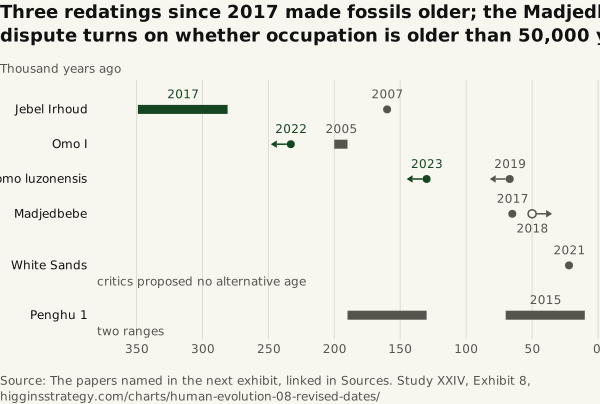
Three redatings since 2017 made fossils older; the Madjedbebe dispute turns on whether occupation is older than 50,000 years
Source. The papers named in the next exhibit, linked in Sources.
Method and data
Method. An arrow marks a minimum (pointing older) or a maximum (pointing younger); the year is the year of publication.
| Item | Estimate | Youngest (thousand years ago) | Oldest (thousand years ago) | Bound | Role | Source |
|---|---|---|---|---|---|---|
| Jebel Irhoud | Electron spin resonance, as used in 2007 | 160 | 160 | point | first | Smith et al., PNAS, 2007 |
| Jebel Irhoud | Thermoluminescence, 315 ± 34 | 281 | 349 | range | revised | Richter et al., Nature, 2017 |
| Omo I | 195 ± 5 | 190 | 200 | range | first | McDougall, Brown and Fleagle, Nature, 2005 |
| Omo I | At least 233 ± 22 | 233 | 233 | min | revised | Vidal et al., Nature, 2022 |
| Homo luzonensis | At least 67 | 67 | 67 | min | first | Détroit et al., Nature, 2019 |
| Homo luzonensis | At least 130 | 130 | 130 | min | revised | Grün and Stringer, Quaternary Science Reviews, 2023 |
| Madjedbebe | About 65 | 65 | 65 | point | claim | Clarkson et al., Nature, 2017 |
| Madjedbebe | Above 50 unlikely | 50 | 50 | max | dispute | O'Connell et al., PNAS, 2018 |
| White Sands | 23–21 | 21 | 23 | range | claim | Bennett et al., Science, 2021 |
| Penghu 1 | 10–70 | 10 | 70 | range | unresolved | Chang et al., Nature Communications, 2015 |
| Penghu 1 | 130–190 | 130 | 190 | range | unresolved | Chang et al., Nature Communications, 2015 |