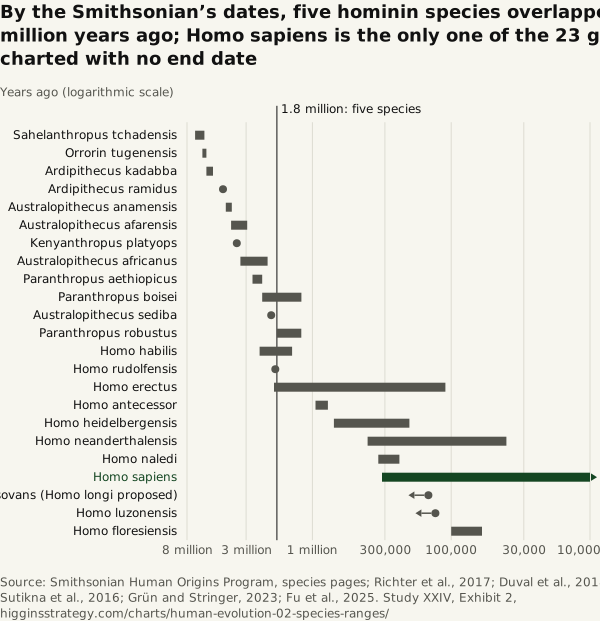
By the Smithsonian’s dates, five hominin species overlapped at 1.8 million years ago; Homo sapiens is the only one of the 23 groups charted with no end date
Source. Smithsonian Human Origins Program, species pages; Richter et al., 2017; Duval et al., 2018; Sutikna et al., 2016; Grün and Stringer, 2023; Fu et al., 2025.
Method and data
Method. Bars span the earliest and latest dates the source gives; single dates are dots; an arrow marks a minimum age.
| Species | Earliest (million years ago) | Latest (million years ago) | Minimum age only | Sites | Region | Source |
|---|---|---|---|---|---|---|
| Sahelanthropus tchadensis | 7 | 6 | Toros-Menalla | Chad | Smithsonian Human Origins Program | |
| Orrorin tugenensis | 6.2 | 5.8 | Tugen Hills | Kenya | Smithsonian Human Origins Program | |
| Ardipithecus kadabba | 5.8 | 5.2 | Middle Awash | Ethiopia | Smithsonian Human Origins Program | |
| Ardipithecus ramidus | 4.4 | 4.4 | Aramis; Gona | Ethiopia | Smithsonian Human Origins Program | |
| Australopithecus anamensis | 4.2 | 3.8 | Kanapoi; Allia Bay; Woranso-Mille | Kenya; Ethiopia | Smithsonian Human Origins Program | |
| Australopithecus afarensis | 3.85 | 2.95 | Hadar; Dikika; Laetoli | Ethiopia; Tanzania; Kenya | Smithsonian Human Origins Program | |
| Kenyanthropus platyops | 3.5 | 3.5 | West Turkana | Kenya | Smithsonian Human Origins Program | |
| Australopithecus africanus | 3.3 | 2.1 | Taung; Sterkfontein | South Africa | Smithsonian Human Origins Program | |
| Paranthropus aethiopicus | 2.7 | 2.3 | West Turkana; Omo | Kenya; Ethiopia | Smithsonian Human Origins Program | |
| Paranthropus boisei | 2.3 | 1.2 | Olduvai; Koobi Fora; Konso | Tanzania; Kenya; Ethiopia | Smithsonian Human Origins Program | |
| Australopithecus sediba | 1.98 | 1.98 | Malapa | South Africa | Smithsonian Human Origins Program | |
| Paranthropus robustus | 1.8 | 1.2 | Swartkrans; Kromdraai | South Africa | Smithsonian Human Origins Program | |
| Homo habilis | 2.4 | 1.4 | Olduvai; Koobi Fora | Eastern and southern Africa | Smithsonian Human Origins Program | |
| Homo rudolfensis | 1.9 | 1.8 | Koobi Fora | Kenya | Smithsonian Human Origins Program | |
| Homo erectus | 1.89 | 0.11 | Nariokotome; Dmanisi; Trinil; Zhoukoudian; Ngandong | Africa; Asia | Smithsonian Human Origins Program | |
| Homo antecessor | 0.949 | 0.772 | Gran Dolina, Atapuerca | Spain | Duval et al., Quaternary Geochronology, 2018 | |
| Homo heidelbergensis | 0.7 | 0.2 | Mauer; Kabwe; Petralona | Europe; Africa | Smithsonian Human Origins Program | |
| Homo neanderthalensis | 0.4 | 0.04 | Neander Valley; Shanidar; Vindija | Europe; southwest and central Asia | Smithsonian Human Origins Program | |
| Homo naledi | 0.335 | 0.236 | Rising Star | South Africa | Smithsonian Human Origins Program | |
| Homo sapiens | 0.315 | Jebel Irhoud; Omo Kibish | Africa, then worldwide | Richter et al., Nature, 2017 | ||
| Denisovans (Homo longi proposed) | 0.146 | 0.146 | yes | Harbin; Denisova Cave; Xiahe; Penghu | Siberia; China; Taiwan Strait | Fu et al., Cell, 2025 |
| Homo luzonensis | 0.13 | 0.13 | yes | Callao Cave | Philippines | Grün and Stringer, Quaternary Science Reviews, 2023 |
| Homo floresiensis | 0.1 | 0.06 | Liang Bua | Indonesia | Sutikna et al., Nature, 2016 |