The 2017 tax law: agreement, then divergence
Source. Joint Committee on Taxation, JCX-69-17, December 22, 2017; Tax Foundation, Preliminary Details and Analysis of the Tax Cuts and Jobs Act, December 18, 2017.
Method and data
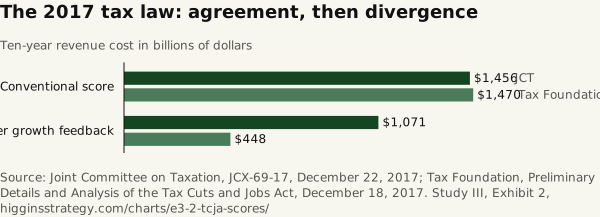
Method. Ten-year revenue cost in billions of dollars, as published. The conventional scores are $14bn apart on a $1.46 trillion estimate — agreement to within one percent. The dynamic scores are $623bn apart. All of the disagreement is in the growth feedback, and it has a named cause: the Tax Foundation’s model treats the United States as a small open economy (Tax Foundation, “Responding to a Critique of the Taxes and Growth Model,” December 5, 2017) in which global capital is highly elastic, so deficit-financed cuts do not meaningfully crowd out investment, while JCT weights three models (JCX-69-17) that, in the Tax Foundation’s account, incorporate crowd-out. A chart placing them adjacent without saying so would mislead.
| Institution | Conventional cost, $bn | Dynamic cost, $bn |
|---|---|---|
| Joint Committee on Taxation | 1456 | 1071 |
| Tax Foundation | 1470 | 448 |
Download SVG · CSV. Data and chart licensed CC BY 4.0.
Higgins Strategy. “The 2017 tax law: agreement, then divergence” Exhibit 2, The Same Question, Different Numbers (Study III). October 12, 2026. https://higginsstrategy.com/charts/e3-2-tcja-scores/