From Study XX · Part 2 of 3, Exhibit 14
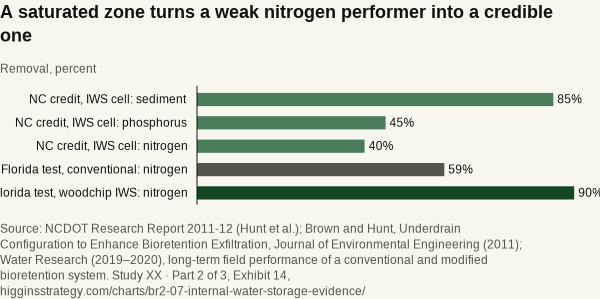
A saturated zone turns a weak nitrogen performer into a credible one
Source. NCDOT Research Report 2011-12 (Hunt et al.); Brown and Hunt, Underdrain Configuration to Enhance Bioretention Exfiltration, Journal of Environmental Engineering (2011); Water Research (2019–2020), long-term field performance of a conventional and modified bioretention system.
Method. The North Carolina values are state crediting values. The Florida values are measured at the lowest hydraulic loading rate tested (4.1 centimeters an hour); at higher loading rates the gap narrows. Neither site is in the Chesapeake watershed; the parallel Maryland–North Carolina–Pennsylvania field program begun in 2007 reports the same design family.
| Measure | Removal (%) | Basis |
|---|---|---|
| NC credit, IWS cell: sediment | 85 | credited |
| NC credit, IWS cell: phosphorus | 45 | credited |
| NC credit, IWS cell: nitrogen | 40 | credited |
| Florida test, conventional: nitrogen | 59 | measured |
| Florida test, woodchip IWS: nitrogen | 90 | measured |