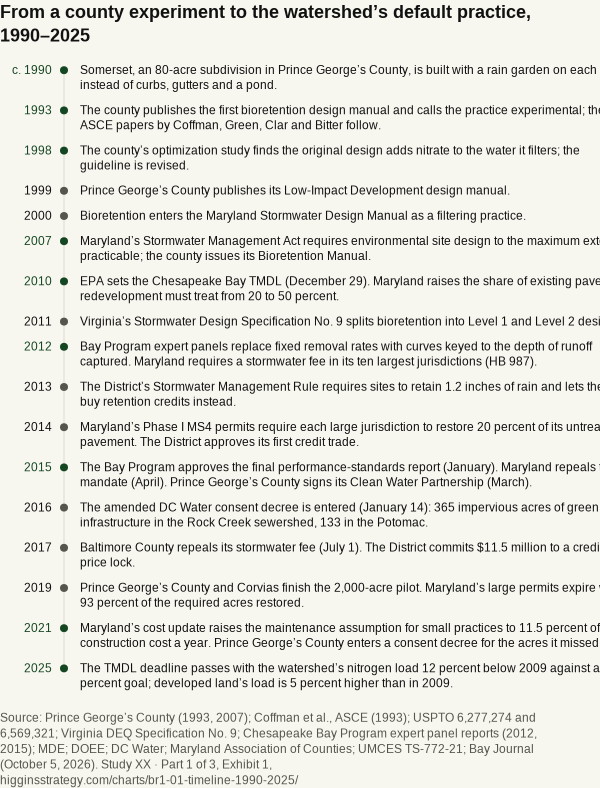
Method. The 2000 and 2007 Maryland dates are as cited in the literature; the manual and the statute were not opened. Events marked in green are the ones this study treats as turning points.
Data table
Year
Event
c. 1990
Somerset, an 80-acre subdivision in Prince George’s County, is built with a rain garden on each lot instead of curbs, gutters and a pond.
1993
The county publishes the first bioretention design manual and calls the practice experimental; the ASCE papers by Coffman, Green, Clar and Bitter follow.
1998
The county’s optimization study finds the original design adds nitrate to the water it filters; the guideline is revised.
1999
Prince George’s County publishes its Low-Impact Development design manual.
2000
Bioretention enters the Maryland Stormwater Design Manual as a filtering practice.
2007
Maryland’s Stormwater Management Act requires environmental site design to the maximum extent practicable; the county issues its Bioretention Manual.
2010
EPA sets the Chesapeake Bay TMDL (December 29). Maryland raises the share of existing pavement a redevelopment must treat from 20 to 50 percent.
2011
Virginia’s Stormwater Design Specification No. 9 splits bioretention into Level 1 and Level 2 designs.
2012
Bay Program expert panels replace fixed removal rates with curves keyed to the depth of runoff captured. Maryland requires a stormwater fee in its ten largest jurisdictions (HB 987).
2013
The District’s Stormwater Management Rule requires sites to retain 1.2 inches of rain and lets them buy retention credits instead.
2014
Maryland’s Phase I MS4 permits require each large jurisdiction to restore 20 percent of its untreated pavement. The District approves its first credit trade.
2015
The Bay Program approves the final performance-standards report (January). Maryland repeals the fee mandate (April). Prince George’s County signs its Clean Water Partnership (March).
2016
The amended DC Water consent decree is entered (January 14): 365 impervious acres of green infrastructure in the Rock Creek sewershed, 133 in the Potomac.
2017
Baltimore County repeals its stormwater fee (July 1). The District commits $11.5 million to a credit price lock.
2019
Prince George’s County and Corvias finish the 2,000-acre pilot. Maryland’s large permits expire with 93 percent of the required acres restored.
2021
Maryland’s cost update raises the maintenance assumption for small practices to 11.5 percent of construction cost a year. Prince George’s County enters a consent decree for the acres it missed.
2025
The TMDL deadline passes with the watershed’s nitrogen load 12 percent below 2009 against a 25 percent goal; developed land’s load is 5 percent higher than in 2009.