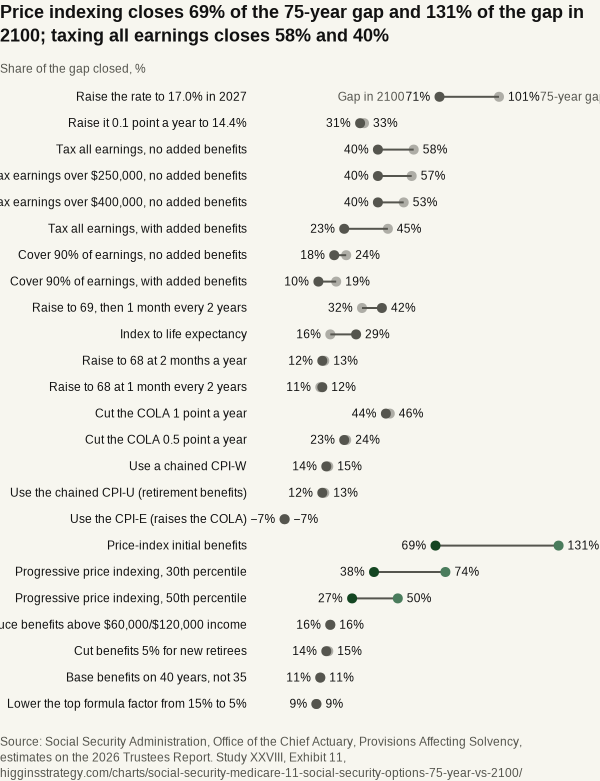
Price indexing closes 69% of the 75-year gap and 131% of the gap in 2100; taxing all earnings closes 58% and 40%
Method. Share of the 2100 gap: change in the annual balance in 2100 divided by that year’s deficit of 6.57% of taxable payroll.
| Provision | Description | Share of 75-year gap closed (%) | Share of 2100 gap closed (%) |
|---|---|---|---|
| E1.1 | Raise the payroll tax rate from 12.4% to 17.0% starting in 2027 | 101 | 71 |
| E1.4 | Raise the rate 0.1 point a year from 2032 to 2051 to 14.4% | 33 | 31 |
| E2.1 | Tax all earnings at 12.4% from 2027; no benefit credit for earnings above the old cap | 58 | 40 |
| E2.5 | Tax earnings above $250000 at 12.4% from 2027; no benefit credit | 57 | 40 |
| E2.17 | Tax earnings above $400000 at 12.4% from 2027; no benefit credit | 53 | 40 |
| E2.2 | Tax all earnings at 12.4% from 2027; benefit credit for earnings above the old cap | 45 | 23 |
| E3.2 | Raise the cap to cover 90% of earnings over 2027–2036; no benefit credit | 24 | 18 |
| E3.1 | Raise the cap to cover 90% of earnings over 2027–2036; with benefit credit | 19 | 10 |
| C1.4 | Raise the normal retirement age 2 months a year to 69 for those 62 in 2038; then 1 month every 2 years | 32 | 42 |
| C1.3 | Index the normal retirement age to life expectancy from 2027 | 16 | 29 |
| C1.2 | Raise the normal retirement age 2 months a year to 68 for those 62 in 2032 | 13 | 12 |
| C1.1 | Raise the normal retirement age 1 month every 2 years to 68 starting with those 62 in 2027 | 11 | 12 |
| A1 | Reduce the annual COLA by 1 percentage point from December 2027 | 46 | 44 |
| A2 | Reduce the annual COLA by 0.5 percentage point from December 2027 | 24 | 23 |
| A3 | Compute the COLA with a chained CPI-W from December 2027 | 15 | 14 |
| A8 | Compute the OASI COLA with the chained CPI-U from December 2027 | 13 | 12 |
| A6 | Compute the COLA with the CPI-E from December 2028 | −7 | −7 |
| B1.1 | Index initial benefits to prices instead of wages for those newly eligible from 2033 | 69 | 131 |
| B1.2 | Progressive price indexing above the 30th percentile of earners from 2033 | 38 | 74 |
| B1.4 | Progressive price indexing above the 50th percentile of earners from 2033 | 27 | 50 |
| B7.7 | Reduce benefits for those with income above $60000 single or $120000 joint; newly eligible from 2031 | 16 | 16 |
| B7.2 | Reduce benefits 5% for those newly eligible in 2027 and later | 15 | 14 |
| B4.2 | Raise the years in the benefit computation from 35 to 40 over 2027–2035 | 11 | 11 |
| B3.14 | Cut the top 15% formula factor 2 points a year from those newly eligible in 2028; 5% for those newly eligible in 2032 and later | 9 | 9 |
Download social-security-medicare-11-social-security-options-75-year-vs-2100.csv