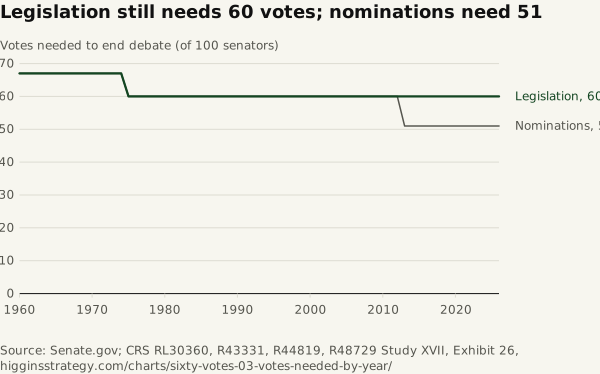
Legislation still needs 60 votes; nominations need 51
Source. Senate.gov; CRS RL30360, R43331, R44819, R48729
Method and data
Method. Before 1975 the threshold was two-thirds of senators present and voting, plotted at its maximum of 67. From 1975 it is three-fifths of senators duly chosen and sworn, 60 of 100. For nominations from November 21, 2013, it is a majority of senators voting, plotted at 51.
| Year | Votes needed, legislation | Votes needed, nominations | Event |
|---|---|---|---|
| 1960 | 67 | 67 | |
| 1961 | 67 | 67 | |
| 1962 | 67 | 67 | |
| 1963 | 67 | 67 | |
| 1964 | 67 | 67 | |
| 1965 | 67 | 67 | |
| 1966 | 67 | 67 | |
| 1967 | 67 | 67 | |
| 1968 | 67 | 67 | |
| 1969 | 67 | 67 | |
| 1970 | 67 | 67 | |
| 1971 | 67 | 67 | |
| 1972 | 67 | 67 | |
| 1973 | 67 | 67 | |
| 1974 | 67 | 67 | |
| 1975 | 60 | 60 | Rule XXII amended: two-thirds of senators voting replaced by three-fifths of senators duly chosen and sworn (60 of 100) |
| 1976 | 60 | 60 | |
| 1977 | 60 | 60 | |
| 1978 | 60 | 60 | |
| 1979 | 60 | 60 | |
| 1980 | 60 | 60 | |
| 1981 | 60 | 60 | |
| 1982 | 60 | 60 | |
| 1983 | 60 | 60 | |
| 1984 | 60 | 60 | |
| 1985 | 60 | 60 | |
| 1986 | 60 | 60 | |
| 1987 | 60 | 60 | |
| 1988 | 60 | 60 | |
| 1989 | 60 | 60 | |
| 1990 | 60 | 60 | |
| 1991 | 60 | 60 | |
| 1992 | 60 | 60 | |
| 1993 | 60 | 60 | |
| 1994 | 60 | 60 | |
| 1995 | 60 | 60 | |
| 1996 | 60 | 60 | |
| 1997 | 60 | 60 | |
| 1998 | 60 | 60 | |
| 1999 | 60 | 60 | |
| 2000 | 60 | 60 | |
| 2001 | 60 | 60 | |
| 2002 | 60 | 60 | |
| 2003 | 60 | 60 | |
| 2004 | 60 | 60 | |
| 2005 | 60 | 60 | |
| 2006 | 60 | 60 | |
| 2007 | 60 | 60 | |
| 2008 | 60 | 60 | |
| 2009 | 60 | 60 | |
| 2010 | 60 | 60 | |
| 2011 | 60 | 60 | |
| 2012 | 60 | 60 | |
| 2013 | 60 | 51 | Nov. 21, 2013 precedent: majority cloture on nominations other than Supreme Court (roll call 242: 48–52) |
| 2014 | 60 | 51 | |
| 2015 | 60 | 51 | |
| 2016 | 60 | 51 | |
| 2017 | 60 | 51 | Apr. 6, 2017 precedent: majority cloture extended to Supreme Court nominations (roll call 109: 48–52) |
| 2018 | 60 | 51 | |
| 2019 | 60 | 51 | |
| 2020 | 60 | 51 | |
| 2021 | 60 | 51 | |
| 2022 | 60 | 51 | |
| 2023 | 60 | 51 | |
| 2024 | 60 | 51 | |
| 2025 | 60 | 51 | Sept. 2025 precedents: majority cloture on executive resolutions and en bloc packages of eligible nominations (roll calls 515, 524) |
| 2026 | 60 | 51 |